

Happy Sunday fellow human,
Hopefully your weekend was well spent. Personally, I got burnt for the first time this year, which, while obviously not something to do every day, is a sign the northern European sun has finally reconnected to a power socket.
Let’s get started with the review. The top three most shared videos of the week, all drawn from the Somatic Academy program: ‘The Defense Cascade - What if the Body Was Trying to Save You?’ were:
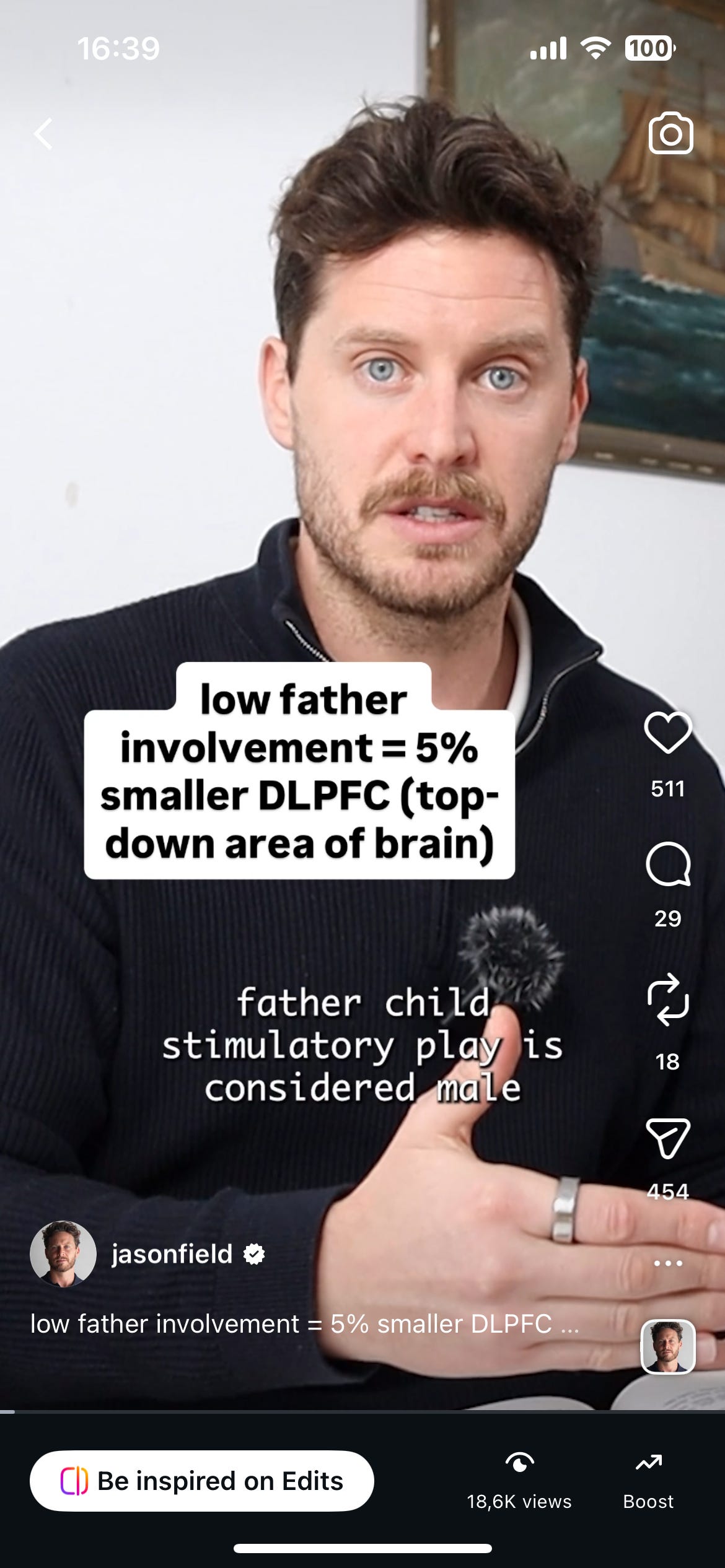
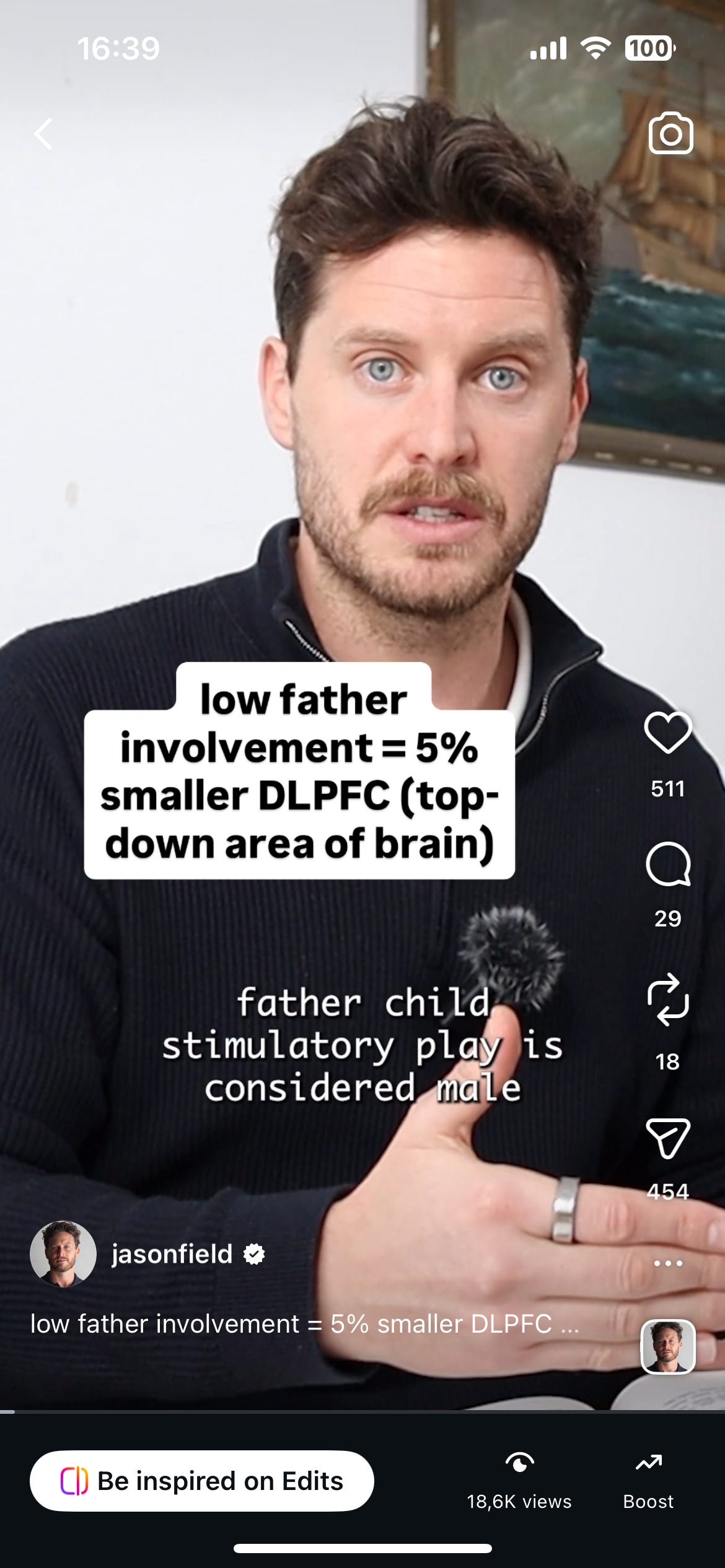
If we check in on the volume of your DLPFC, a critical portion of our top-down control centre in the brain, then ask how involved your father was in your upbringing, the participants who answered ‘low father involvement’ had on average a 5% smaller DLPFC. What is the DLPFC volume associated with? It is 8% smaller in ADHD, and it is negatively correlated with impulsivity scores and positively correlated with GABA levels. What has Dad got to do with this? Our brain is formed, in part, due to neural synchrony. Our parents, in our presence, link up with us, growing areas deemed significant to copy/paste the prior generation’s responses. Smart right? But hang on, we still haven’t answered, what has Dad got to do with this? Answer: he lights up in the DLPFC when looking at his child, when his baby cries, when he plays with his child, and when he problem-solves with his child. Mum, on the other hand, lights up in the emotional area of the brain, which, when dad does, is inversely associated with oxytocin levels, and when mum lights up in the top-down region with her child, it predicts insecurity of attachment. Mum is embedded with the super skill of bottom-up regulation, and Dad is embedded with the super skill of top-down regulation. When Dad is not involved in our upbringing, we miss a critical step in our development. Is this fate? No, for example, Catholic nuns have a 28% larger DLPFC. We have plenty of tools to mould our brains, but currently our mass-market approaches tell us the state of our bodies is irrelevant, and our culture tells us ‘all a child needs is love’ while being unwilling to define what that means.
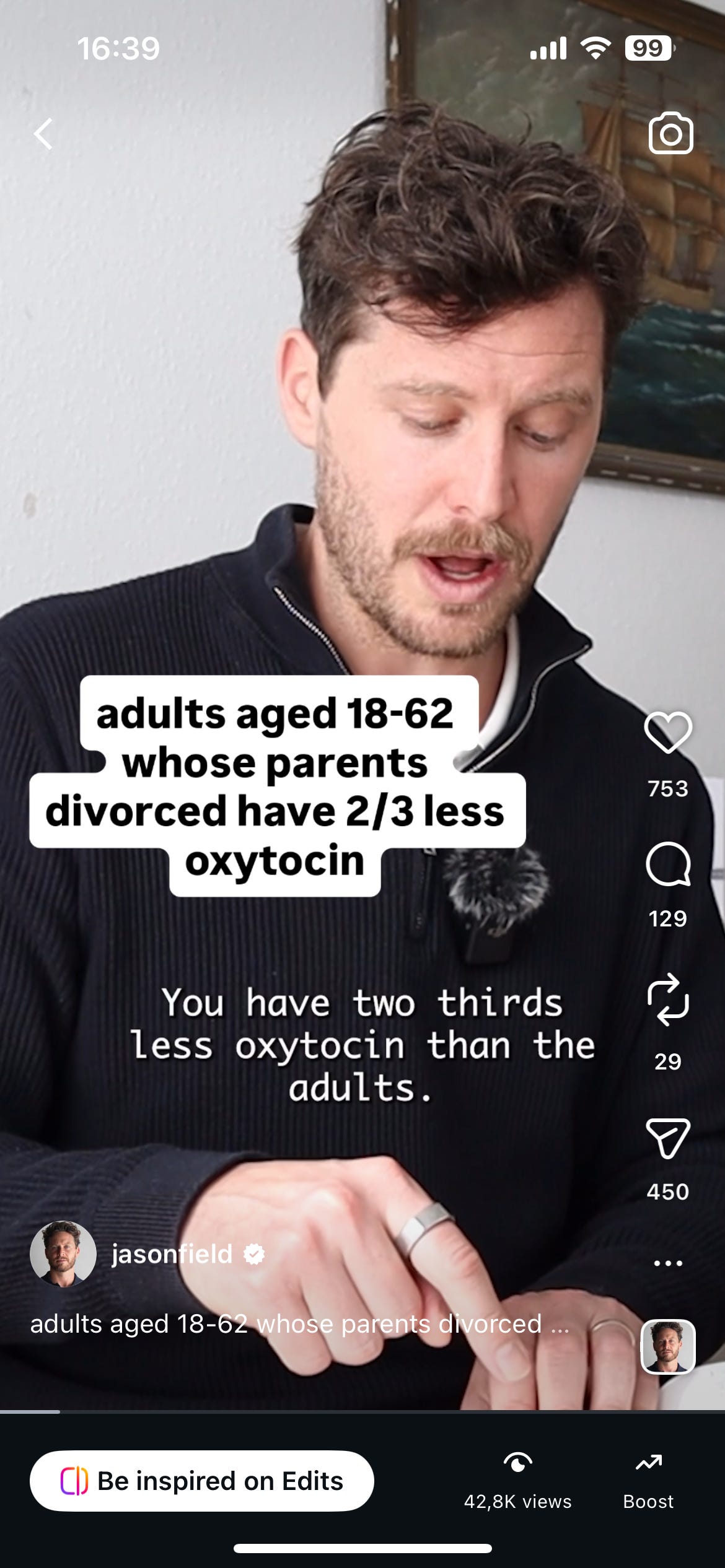
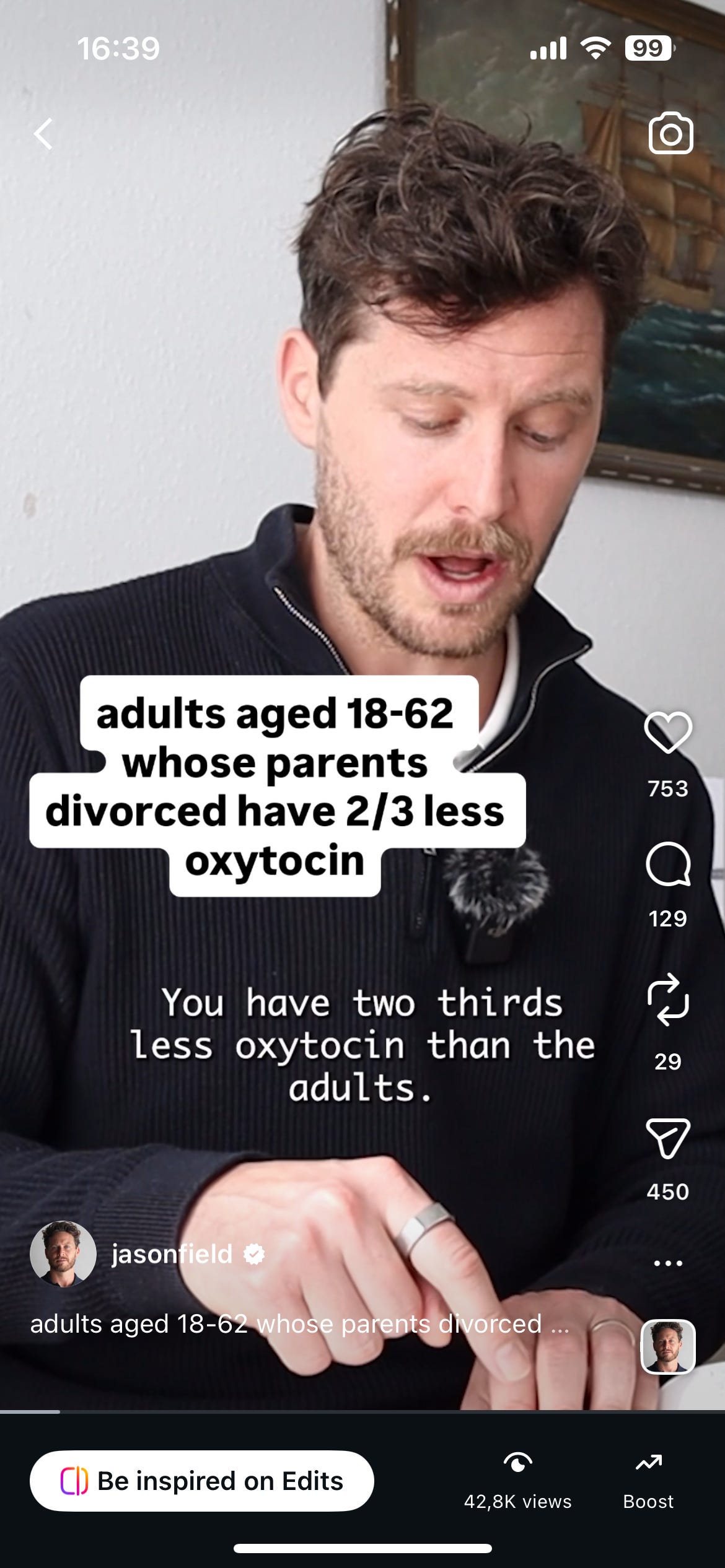
On a similar topic, the second-most-shared video featured findings from a study of adults aged 18-62, who, instead of ticking a box for low or high father involvement, ticked whether their parents were divorced or not divorced. Those who ticked ‘divorced’ had on average 2/3 lower oxytocin. Remember, oxytocin is a proxy for endogenous opioids, and separate studies have shown evidence of a near halving of endogenous opioid expression in adults who report parental separation. This is also what we see from trauma and unresolved loss events. Endogenous opioids are negatively correlated with attachment security, emotional suffering scores, anxiety symptoms, depression symptoms, autism symptoms and are what ADHD medication increases almost as much as cocaine. The mantra comes to our mind once again: what if the root of our suffering was our separation?
The third video, which continued the theme of ‘topics that make us feel uncomfortable but are critical for our species survival,’ was an illuminating study on cortisol synchrony between mothers and their infants. While oxytocin and cortisol synchrony between parents and children is well known, in this instance, the synchrony travelled across time and space. Mothers engaged in a positive or negative conversation, then played with their child, then the child faced a challenge. The infant's cortisol levels were a carbon copy of mum’s cortisol levels during her positive or negative conversation, but in a different room at a different time. Once again, until we recognise that children are mirrors unto us, we are unlikely to overcome the cultural poverty that loops behaviour into personalities, personalities into diagnosis and diagnosis being met with dispensary. Do we prioritise safety in the body? Or do we prefer to outsource the consequences of our non-safety to others? When that other is us, will mass market attempts meet us with confusion as to why we are in such a state, or compassionately meet our circumstances so that we can break the intergenerational cycles? It’s up to us.
So what can we do to become the agents of our own rescue? Picking up the anterior insula region of the brain may help us, because
Activation is negatively correlated with loneliness scores.
Activation is negatively correlated with ADHD symptom severity.
It is almost turned off in autism.
What is this region of the brain associated with? Trust. Which is simply another example that the conditions we were told were healthy variations, however, ones we only received a diagnosis for by successfully ticking deficit boxes, is, at least in part, a separation problem.
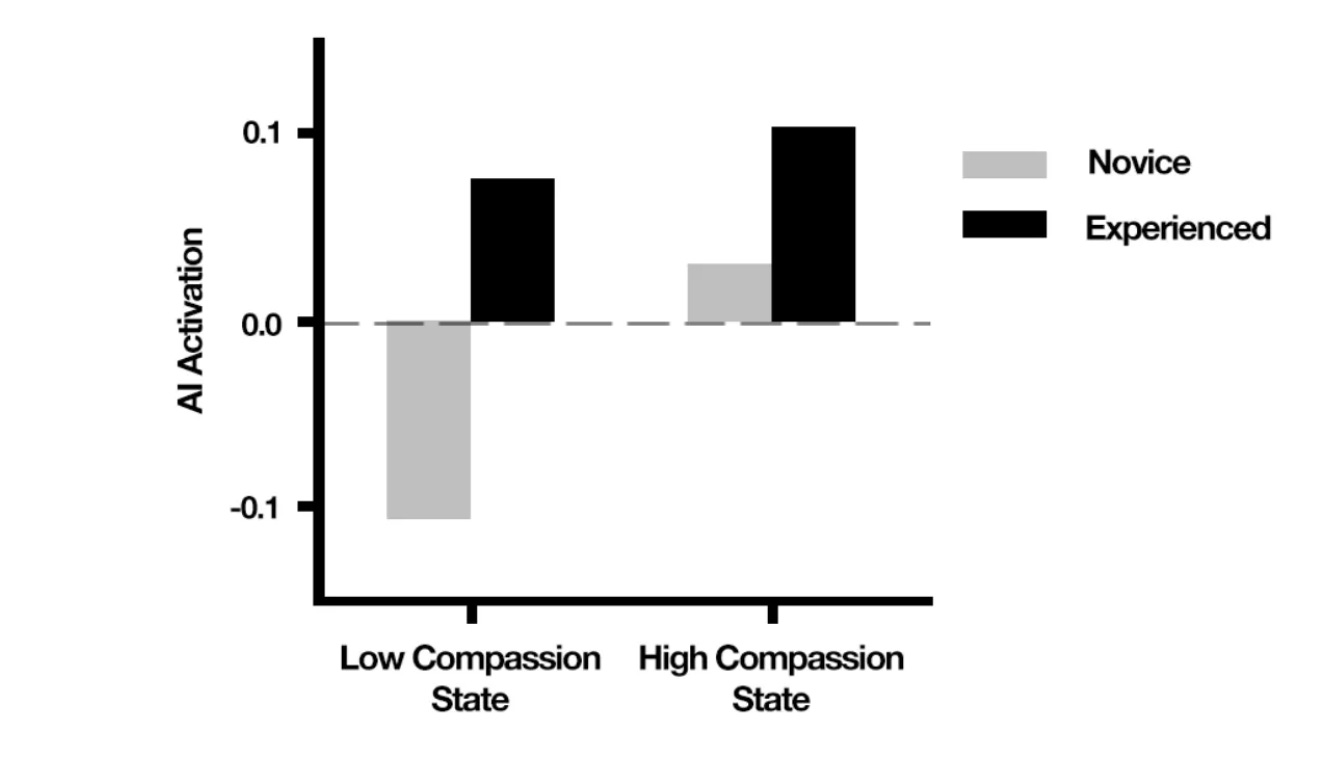
Should we wish to turn back on this region, what options do we have? One very low-hanging fruit is loving kindness meditation (which we frequently practice in our Monday Meditations). Novice practitioners who achieved a high compassionate state were able to activate this area of the brain, whereas experienced practitioners had a higher baseline and also showed greater activation during high compassionate states.
In other words, when your grandparents said prayers with your parents when they were children, such as:
Now I lay me down to sleep,
I pray the Lord my soul to keep;
If I should die before I wake,
I pray the Lord my soul to take.
Before asking for God’s blessings for relatives, friends, and family pets, this was a very similar exercise.
From this perspective, we begin to see that non-affiliation is a worldview. It doesn’t mean we have to all become affiliated, but it does mean that many of the support structures that were building our brains have been removed, and we would likely benefit from recognising that and asking ourselves what we will replace them with.
Looking forward, this week’s Monday Meditation is an exercise in somatic unification of emotional experience.

What does that word salady mean? In short, it's the famous question: ‘Where do you feel that in the body?’ In long, it is identifying that energy (not hoobeegoobee magic, but unfinished survival responses) resides in the body at predictable locations that align with a predictable set of emotions.
When we start to understand that our body is trying to save us, and that emotions are calling cards for that desire, this exercise helps fill the gap with the physical movement desired from our body, which is trying to save us, with an arising of emotion, to meet a moment.
Practising this helps us not only free ourselves from being hostage to our emotions, but also builds a container for somatic reintegration events. I’ve shared a particularly powerful example in my own healing journey where my hand pulled tightly into a fist unprompted, which was a reflex of my body trying to pull the brake on the motorbike of my mate, who was tragically killed in an accident with an intoxicated driver.
Cognitive approaches will call that irrational, whilst at the same time handing out magic beans that are also used as an alternative to chemical castration in prisons, and call that rational. Surely we can do better.
Lastly, this week marks the one-month anniversary of the Somatic Academy launch. Overwhelmed with the response in such a short period of time, and so pleased that there are people, particularly front-line defenders, who are thirsty for an upgrade to our species software for how we meet disorganised states.

I’ll leave it there for now.
As always, to your healing 💙,
Jas