

Happy Sunday fellow human,
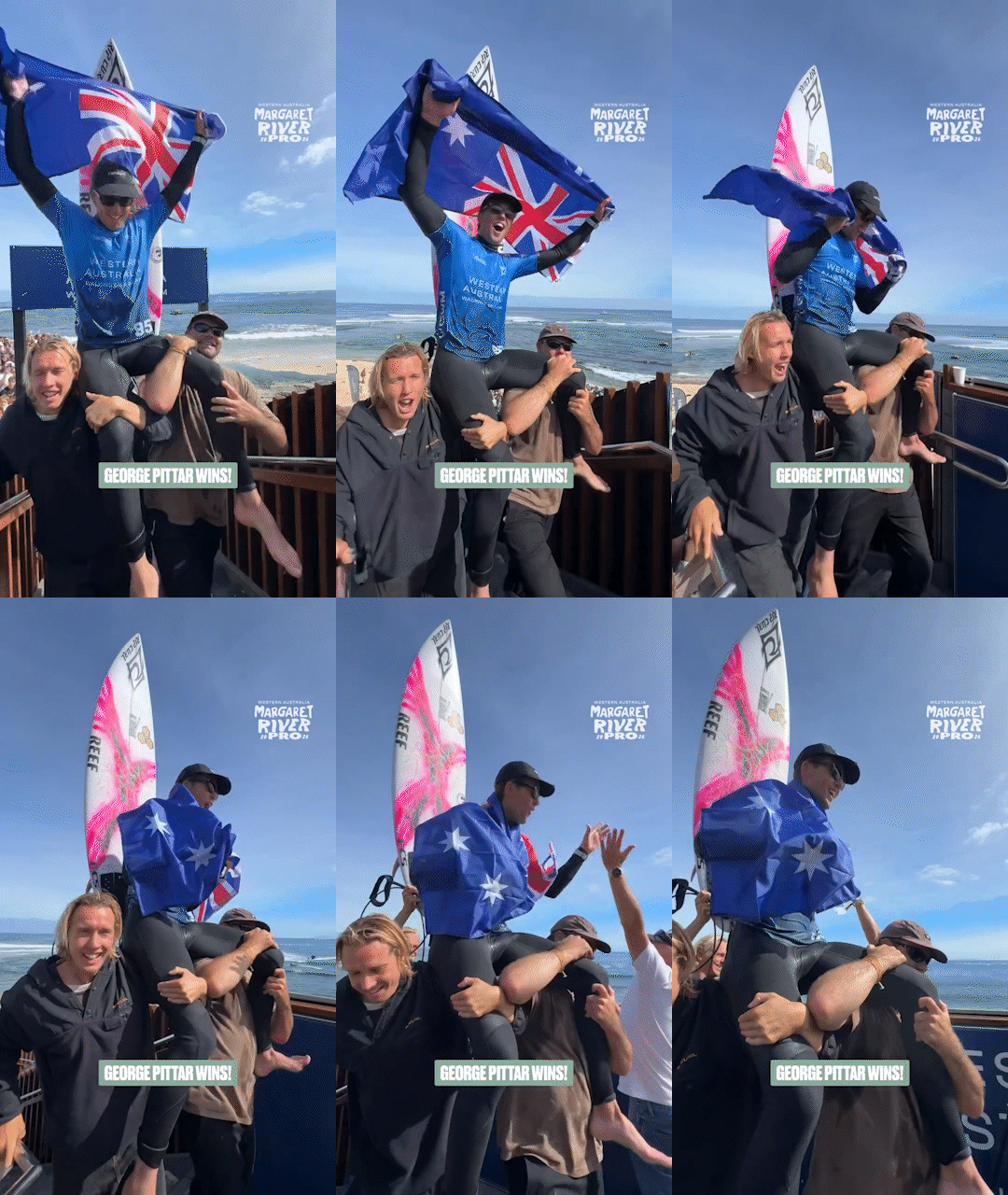
Hope you’ve managed to enjoy yourself this weekend. Personally, I’m still on quite a high after George Pittar came away with a win at the Margaret River event for the World Surfing League. Incredible talent.
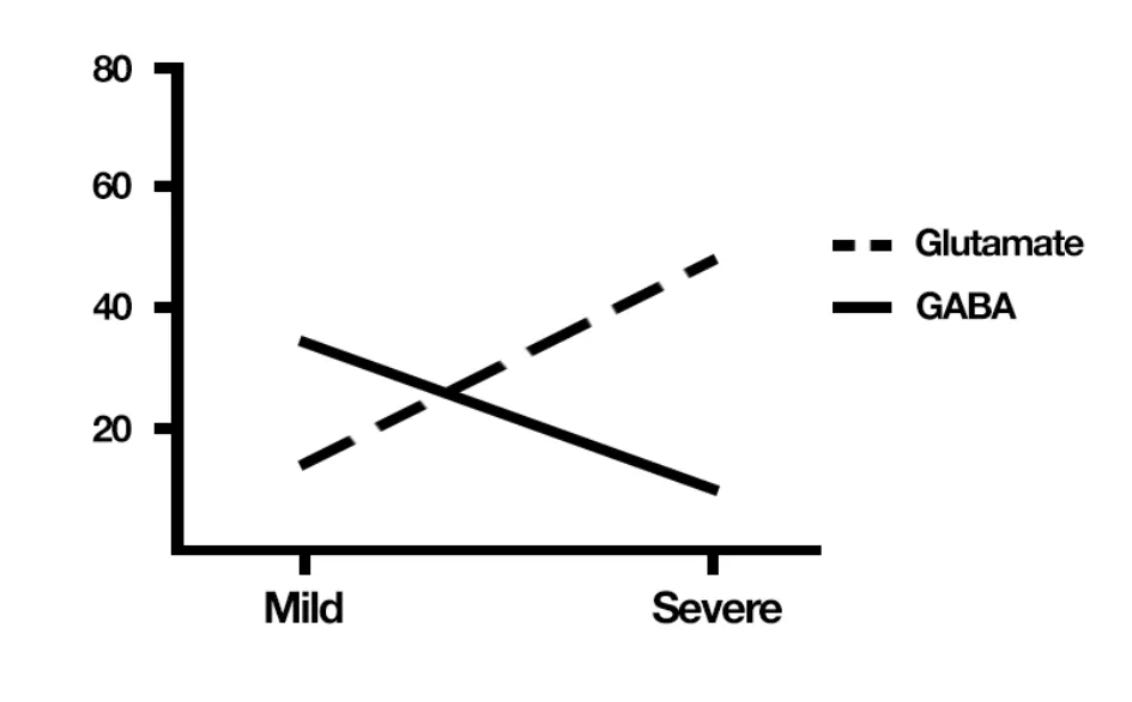
Let’s start the review this week with the work on program two. I thought I would share a couple of charts. The first reminds us that when we talk about GABA (our primary inhibitory neurotransmitter), there is always a counterparty in glutamate (our primary excitatory neurotransmitter). When that balance is disrupted, peace is likely quite far away from us.
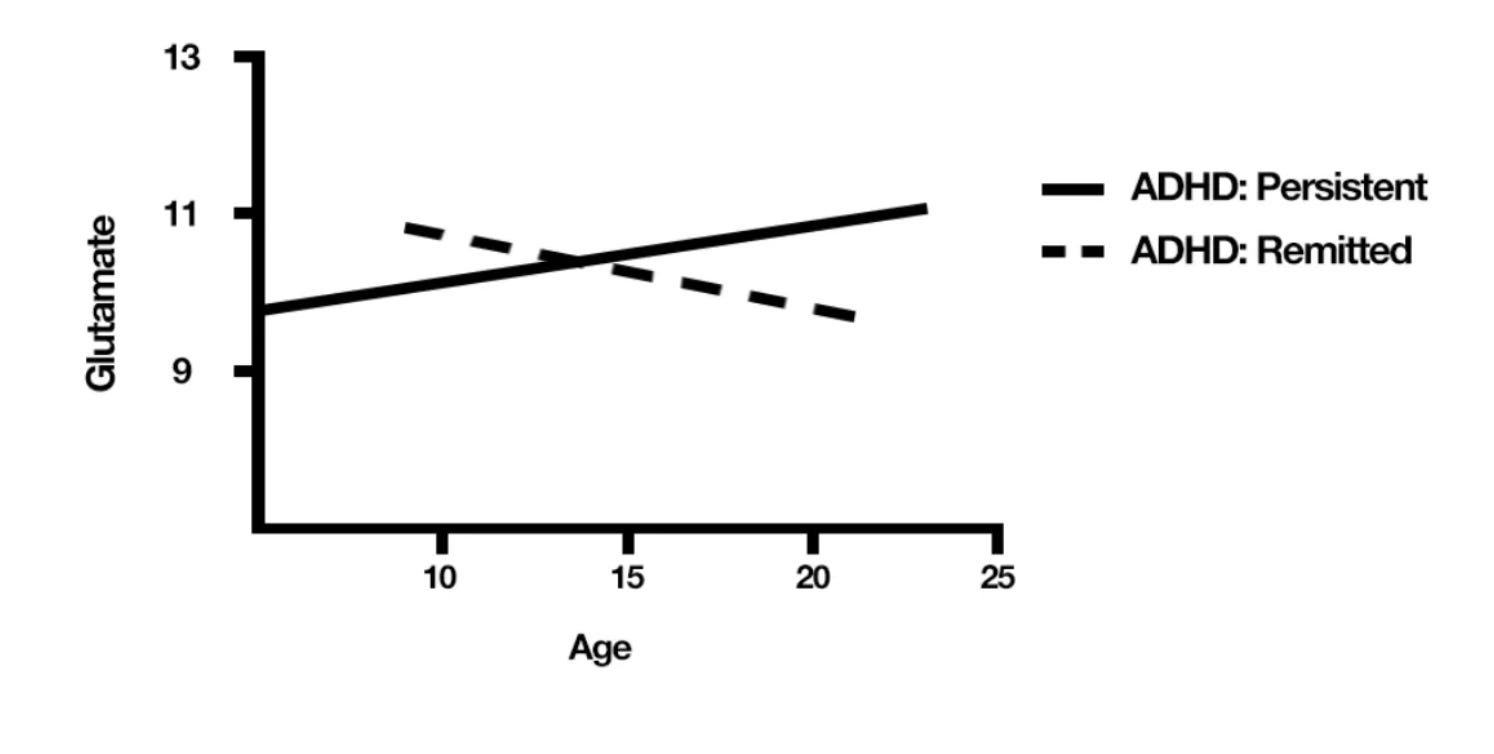
What conditions are associated with high glutamate? Almost all. Depression, OCD, PTSD, autism, ADHD, but fascinatingly, it is what differentiates persistent ADHD from ADHD that we grow out of.
This, of course, reminds us of step 1 in a body-led approach: safety. If we have not met ourselves in a downregulated state, why is that? Do we have a toolkit to take ourselves to calm? Are we prioritising the necessity to do so? The answers to both of those questions culturally skew us towards no and no, because our default mode today is hypervigilance. That being the case, we use words such as ‘can’t’ which is a terribly sad construction of a great ceiling over our experience.
Complementary to this predicament, this week’s Monday meditation takes us through a somatic shake-out.
A useful tool when we find ourselves halfway (or more) up The Defense Cascade. For example, people diagnosed with panic disorder often find meditation difficult, and the science backs that up. While healthy controls show increases in BDNF (a protein that is a near necessity to extinguish our fears), panic patients actually show declines. Why? Because we require re-mobilisation (we are in a passive defensive response). Stopping can provide a gap for survival responses to escape into that we are yet unable to contain. Personally, I’ve experienced panic attacks in the past while trying to do yoga. That was not what the body was asking for.
So we get familiar with our location on the Defense Cascade, and we regain our sovereignty over our energetic experience by accessing a broad toolkit of arousal management. Perhaps today the best tool is a shakeout, perhaps tomorrow is some deep breathing, perhaps the next day it is really stretching out our time in shavasana. That’s having a mature relationship with a bodily vessel.
Moving on to the top three shared videos this week, all clips from program one of the Somatic Academy, ‘The Defense Cascade - What if the Body Was Trying to Save You?’
First up is swapping self-compassion for self-esteem when we are targeting stability of self-worth. Self-esteem is relative. Relative to what? Other people. This evolutionarily is quite intelligent. 150 people in a village, I feel a little crappy about my behaviour, I chop off the aversive parts of myself and social cohesion is maintained. When there are 8 billion people, this approval process is severely corrupted. So we bring home the judgment, and we practice self-compassion. This has been shown to be far more strongly associated with self-worth and is naturally related to our capacity to show compassion to others.

Next up, we touched on the manufacture of a people-pleasing perfectionist. If we were aliens playing with human DNA, the easiest way to create a person who would behave in such a way is to make them insecurely attached to their parents; then the games begin. That child becomes an adolescent, who becomes an adult, constantly tying their internal state to the outcome of others they can’t control. This, of course, builds the case for burnout, because we are waiting subconsciously for that tap on the shoulder that says: “You did it, you are enough, you can rest now.” That of course never comes, and so once again, we have to adopt ourselves. We start investigating, in a state of downregulation, who we are when we are not trying to validate ourselves through the assumptions of what other people may or may not like in us.

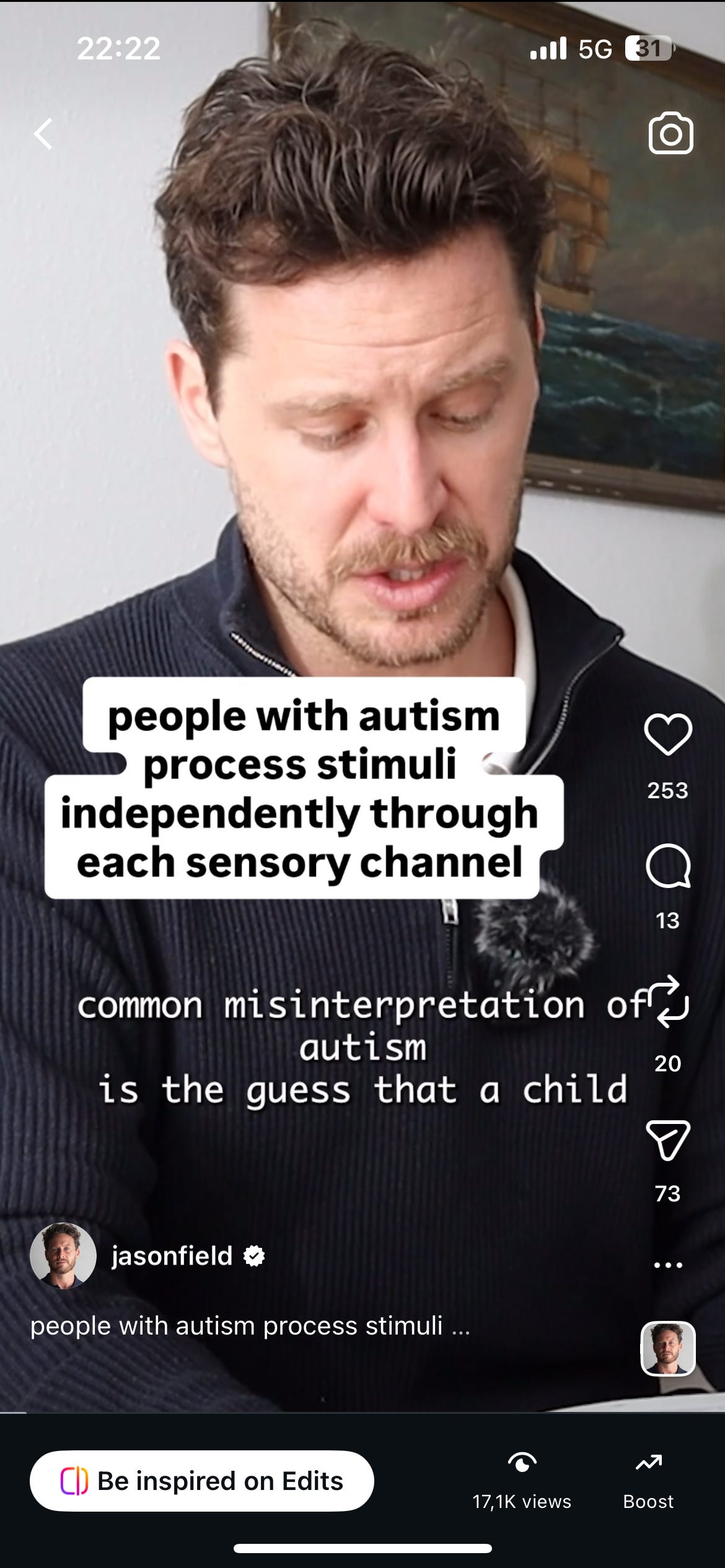
Thirdly, we have sensory processing in autism. Unfortunately, what makes social engagement both overwhelming in the moment, and time-consuming to overcome the exhaustion afterwards, is the absorption and digestion of sensory stimuli independently, i.e., eyes, ears, touch… Instead of a coherent picture, fragmentation exists, and this is yet another example that is shared with trauma, PTSD patients do exactly the same. What increases the severity of this? Glutamate levels.


Over to the Somatic Academy, where I’m very pleased to say we had the biggest week yet. Warm welcome to all new participants, certainly hope the offering serves you well :)
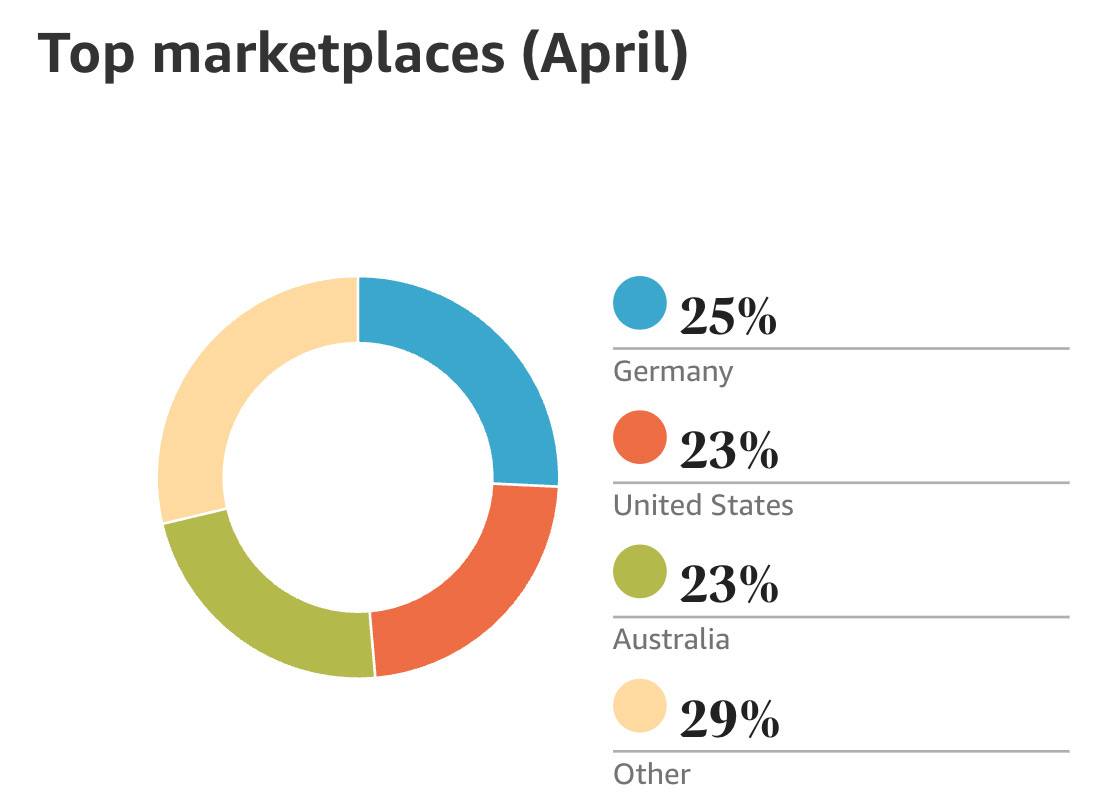
Regarding the podium finishes, Germany retains top spot, while the US has squeezed itself into a tie for second with Australia.
🥇🇩🇪 🥈🇺🇸🥈 🇦🇺
Alrighty, I’ll leave it there for now. Have a great start to the week.
As always, to your healing 💙,
Jas