

Happy Monday fellow human,
Hope the weekend was well spent, and a big happy Mother’s Day to the parts of the world where yesterday honoured those who fulfilled the sacred role of bringing every single one of us to life. Here, here to mum.
Let’s wrap up the week that was, starting off with our top three shared videos, as always, excerpts from the Somatic Academy program: ‘The Defense Cascade - What if the Body Was Trying to Save You?’
In reverse order, we have the reminder that the sickest COVID patients in the ICU were men with high estrogen (and women with high testosterone, but that’s for another day).
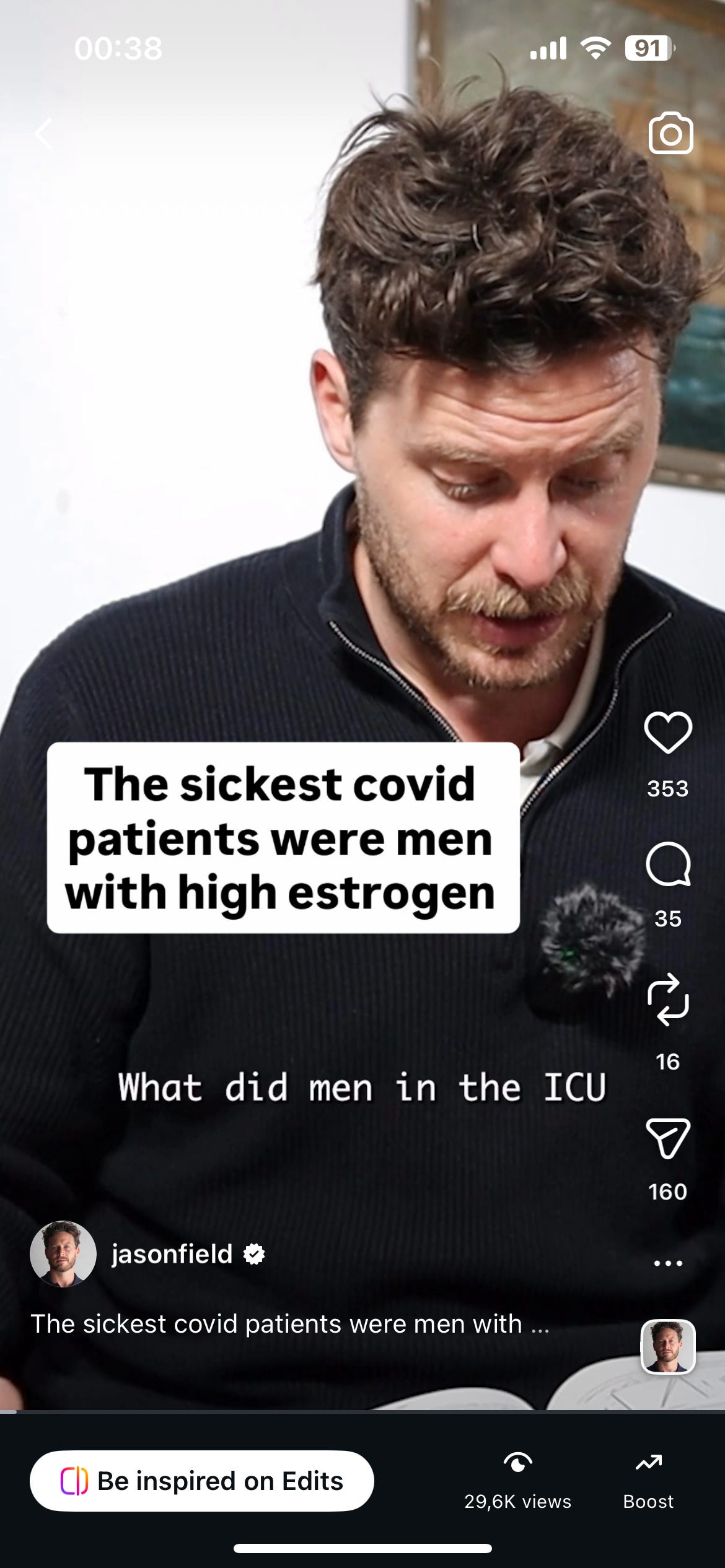
COVID, of course, is not the topic of discussion. What we are reminded of is the role of sex hormones and our wellness. If we truly would like health and well-being, targeting age-adjusted fertility is one of the most powerful metrics available.
When men are stressed, their testosterone gets converted to estrogen rapidly due to estrogen’s role as an anti-inflammatory. Which is why estrogen in men is positively correlated with anxiety, depression and anger scores. The body is trying to save us from inflammation, help us recognise the unsustainability of our situation with sadness, and ring-fence our experience with fear and anger.
The best part of this scenario, though, is that testosterone is bidirectional. Stress and inflammation reduce testosterone, but testosterone reduces stress and inflammation. Not only that, we will feel more connected, pro-social, and more likely to help others, because testosterone directly hits endogenous opioid receptors (endorphins).
But weren’t we told that testosterone = anger? That’s our cultural poverty at work again. Cortisol predicts anger across a man’s lifecycle. We don’t blame a sex hormone for what a stress hormone did. We need that body, like every other, to be downregulated and taken back to safety.
Next up, we have kindergarten kids with ADHD doing yoga. After just 12 weeks, hyperactivity decreased by 31%, and inattention decreased by 41%.
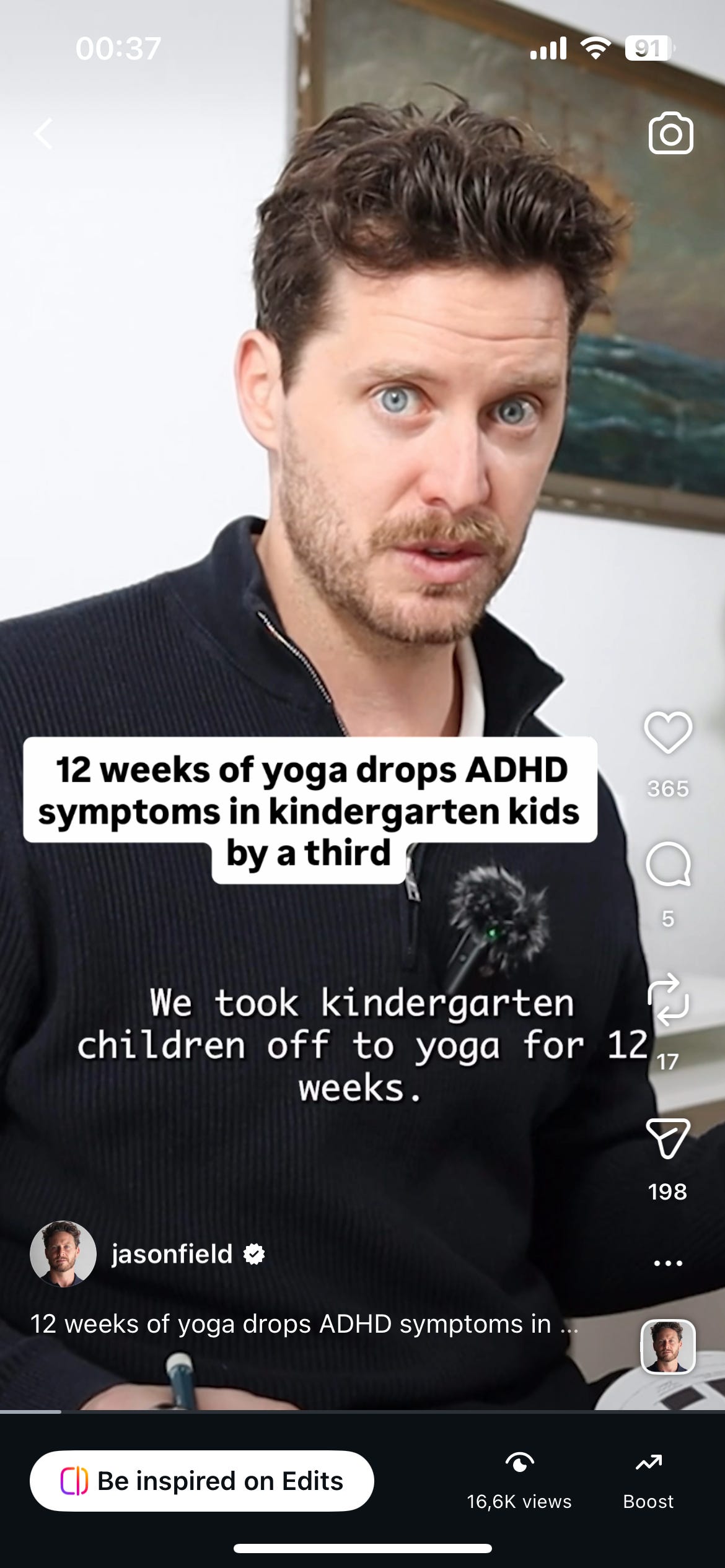
We receive another reminder, ADHD is not fate, it is not a healthy variation, it is not an authentic expression, it is a survival response. We can create it on a probability basis with an ingredient list that involves trauma, pollution, inflammation, insecure attachment, elevated personal distress scores and one or all of those can begin three generations ago.
The most shared video this week involved the passive defense response of falls in cortisol during trauma assessments in children with high early life adversity.
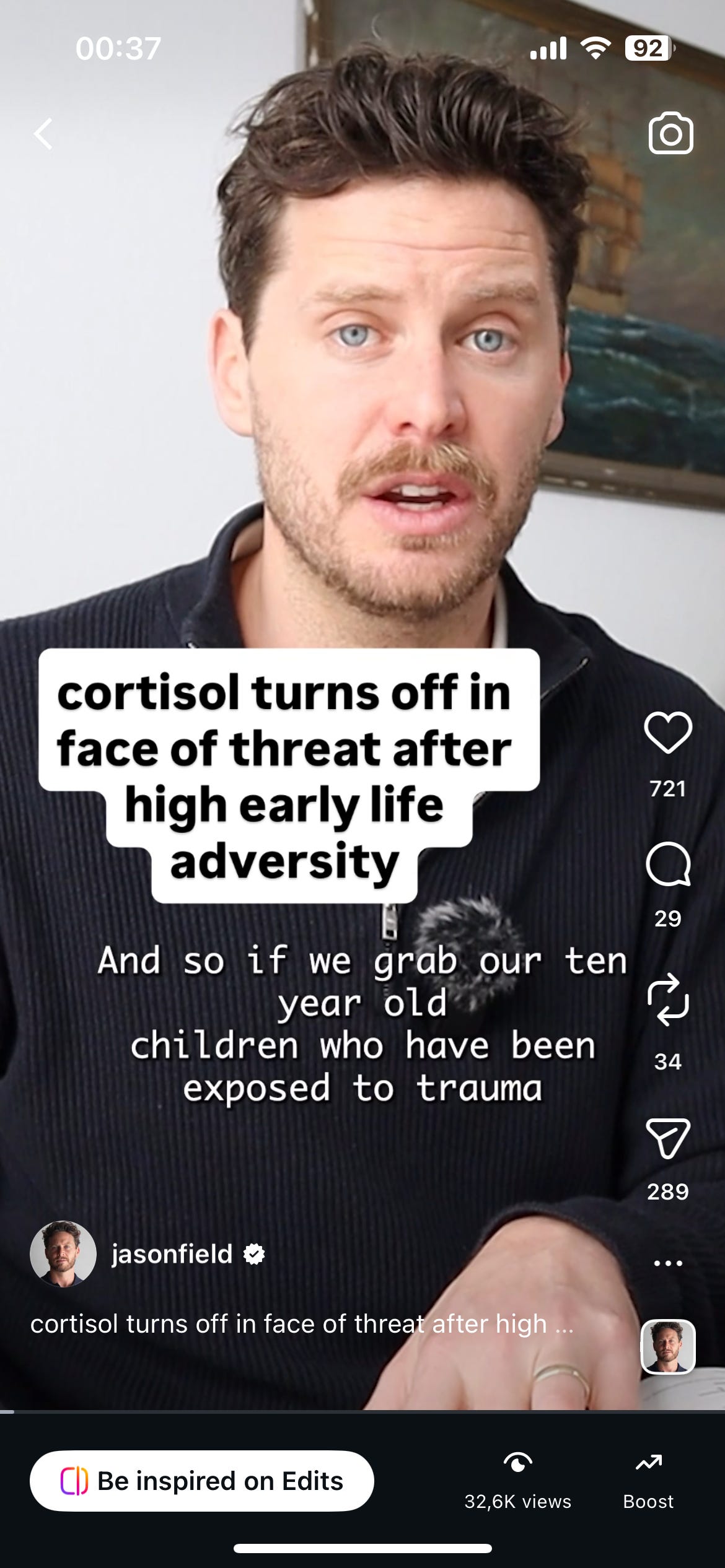
This video is, perhaps obviously, a passion point of mine. The software we embed in frontline defenders that spills into the minds of the wider public is relaxed or fight/flight. But the body is a lot smarter than that, and we have known it is a lot smarter than that, for a long time. It’s a shame that it has not filtered through to mass market approaches.
Sadly, by excluding a review of the circumstances of someone in their body (in this case, children), we don’t recognise that even our rescue attempts can be re-traumatising. This is also not confined to a minor percentage of the population.
For example, one-third of PTSD patients oscillate between shutdown and hyperarousal in a single session. For example, PTSD patients and panic patients often experience falling cortisol and rising norepinephrine under stress conditions, whilst healthy controls do not. That SAM/HPA ratio is a quick proxy for shutting down our cognitive lights that will only be turned back on when our body (not our mind) perceives it is safe to do so.
Moving on to this week’s Monday meditation with its focus on forgiveness. Why compassionate meditation works so well is not because we allow ourselves to be human; it’s because we allow everyone to be human. We assume ignorance before malice, we assume suffering before wisdom. In that way, we can work towards alleviating some of the common emotions that rise up when we have been wronged, such as shame and guilt.
Why do we feel shame and guilt when we are the injured party? Because if we were ‘enough,’ other people would either not see us as hurtable, or help prevent us from being hurt. Because if we were ‘enough,’ we would be able to save ourselves from being hurt in the first place. Naturally, all arrive at the same destination of a low sense of self-worth, something within our realm of influence.

Regarding work in progress, a very interesting study found that practising breathing at 6 breaths per minute increased the volume of the left OFC region of the brain.
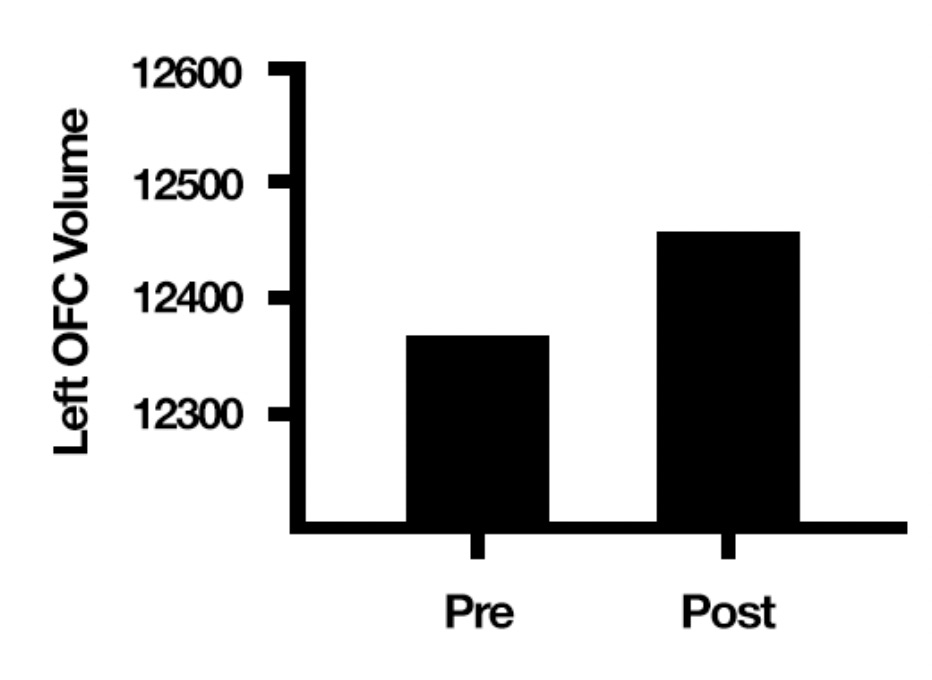
Who has a smaller left OFC? People diagnosed with ADHD, and especially people diagnosed with ADHD and ODD.
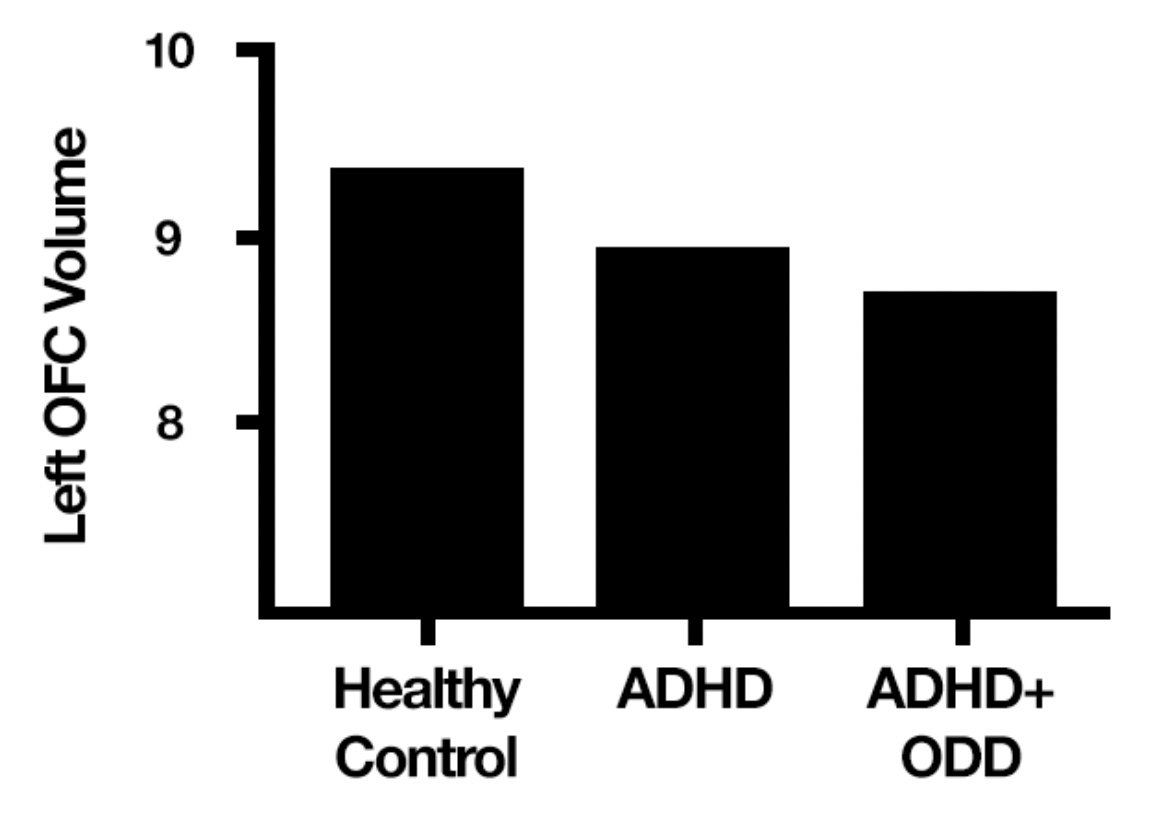
Why do we have a smaller left OFC? Because of epigenetic (gene x environment) changes to our oxytocin receptors, which walk side by side with our insecure attachment.
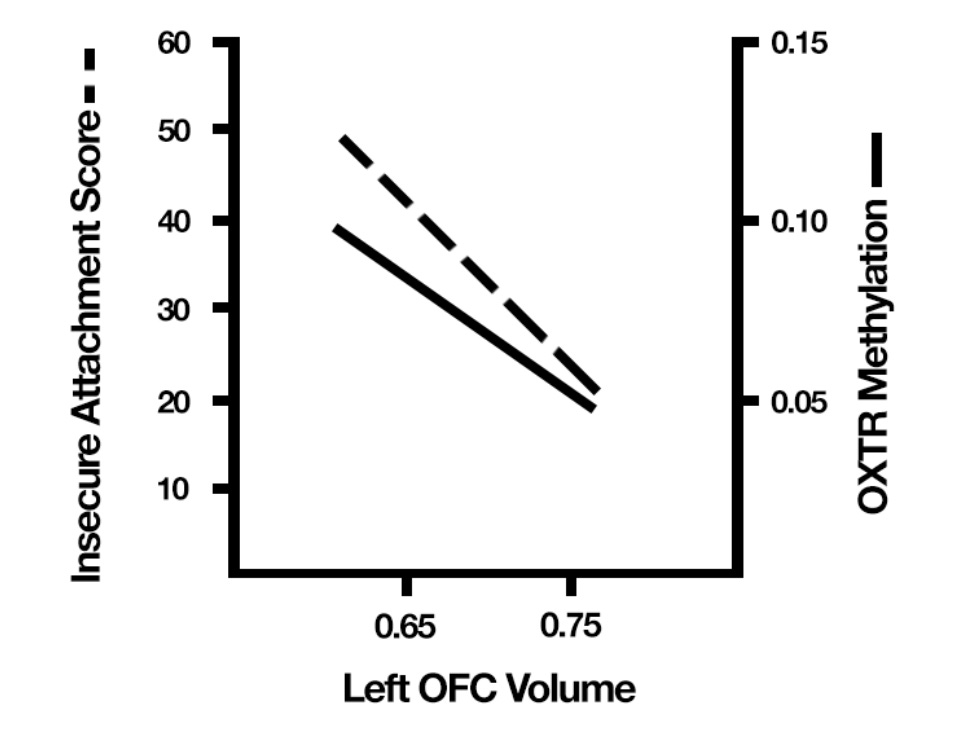
Yes, once again, we arrive at the same point we always will: what if the root of our suffering was our separation? Why don’t we talk about this? Because as a culture we have decided to pretend that we are isolated DNA blobs accidentally running into each other, which is not only factually incorrect but also makes us all unhappy. When we put up our hand, or the hand of a loved one, for help, we are high-fived with a pack of magic beans. Terrible state of affairs, particularly given the knowledge we hold in the species library.
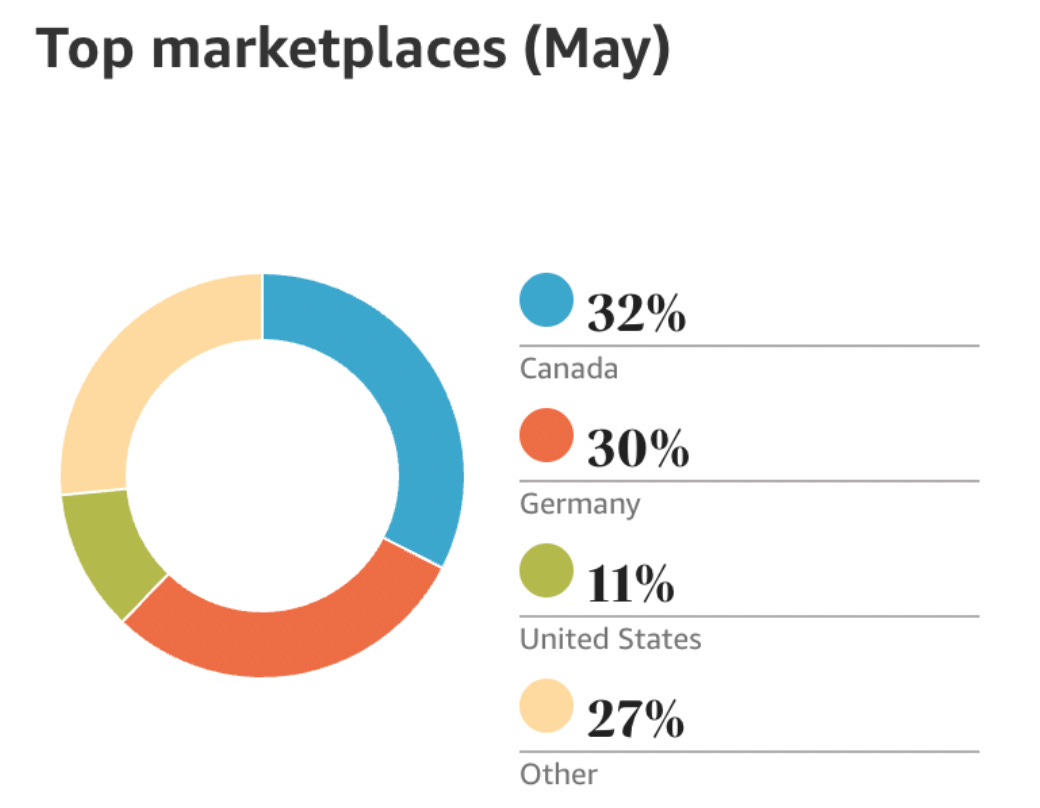
Lastly, we review the medal tally for May. In a surprising turn of events, we see a new entrant: Canada, eh? Close behind is the Deutschland, and coming up tail the USA. This week, the homeland of Australia falls away into ‘other,’ but that’s ok, we are used to that :)
🥇🇨🇦🥈🇩🇪🥉🇺🇸
Should you perceive the program to be helpful to your circumstances, there’s a button below that leads to more information.

I’ll leave it there for now.
As always, to your healing 💙,
Jas