

Greetings fellow human,
Been a while between drinks, I do hope your start to the year has been smooth :)
Last year was quite the whirlwind with 5 books written, and their consolidation into ‘Who Brought You Here.’ A ride that delivers us to today.
This project has always been one focused on working, listening and refining with the same goal under the big umbrella of healing. For those who have been with me since the start, you have seen the evolution from candid relays of my own therapy journey way back when with ‘Thursday Therapy’ notes, that morphed into podcasts (1), (2), and (3), that morphed into weekend retreats and finally the book offerings.
What has become, surprisingly, unavoidably apparent is that the area of highest demand is frontline defenders. My work was always focused on the patient side. That surely other people out there were just as frustrated as I with the magic beans or cognitive approaches to complex human problems. Approaches that silo observations into labels often lead to a subscription and highlight our species' lack of understanding of the truth that lies beneath.
I’ve been familiar with this my entire life. As a kid, I would go to sleep hooked up to a ventilator machine. My eyes would water as a stress response when I was in front of people I didn’t know. I was taken to a hearing specialist because the teacher at school thought I was deaf, because I didn’t speak. Doctors suggested I could surgically remove my sweat glands because of the dinner plate-sized sweat marks on my school shirts. At each step, a new label, some more medication, and a larger suitcase of: “I guess it’s just me.”
Anyway, I subconsciously ‘masked up’, worked hard, ticked all the right boxes, got into the corporate world, only for it all to fall down around me. Burnout, panic attacks and an inability to even take out the garbage from my house for fear of other people. A scenario that surprised me, my loved ones, and, sadly, someone with an eight-year degree.
I went to the psychologist, and there, I was told that maybe medication could be a good idea, and in a gesture not too long after those words, I was handed a piece of paper that said, ‘Catastrophizing: What is it?’ with a little cartoon character running around making a big deal out of small moments. I never felt so small. I never felt so misunderstood. I never felt so hopeless.
Fast forward three years, and I was back in the exact same position, fast forward three years, and exact same again. All along the way, all I was given were cognitive tools and prescriptions that I didn’t respond to. Then came my somatic Teacher, and the cycle finally broke, which brings us back to Therapy Thursday, because those successes were also what other people were keen to hear.
Since the book launched last year, however, the biggest requests have been for training. Every alphabet soup acronym you could imagine is attached to email signatures. What I have since realised is that there are an enormous number of practitioners who are well aware of the ineffectiveness of the software they were loaded with, particularly once you move past fight/flight.
What has been of particular interest is the intersection of life experience with [insert label of condition], how body-led approaches found success, and also, why. That last part is important because we live in low-trust times today. We have a very high burden of proof to believe anything, I know, I’m one of those people with that elevated threshold.
Incidentally, from my need to know ‘why’ the somatic tools work, as an always-journaler, I would make copious notes and follow up with extensive research into where replication has been carried out elsewhere. Those notes have come in handy.
So we have a rare opportunity to experience the butterfly effect. Provide frontline defenders with complementary tools, along with the footnotes explaining why, and we appear to be in a cultural moment where real change can occur.
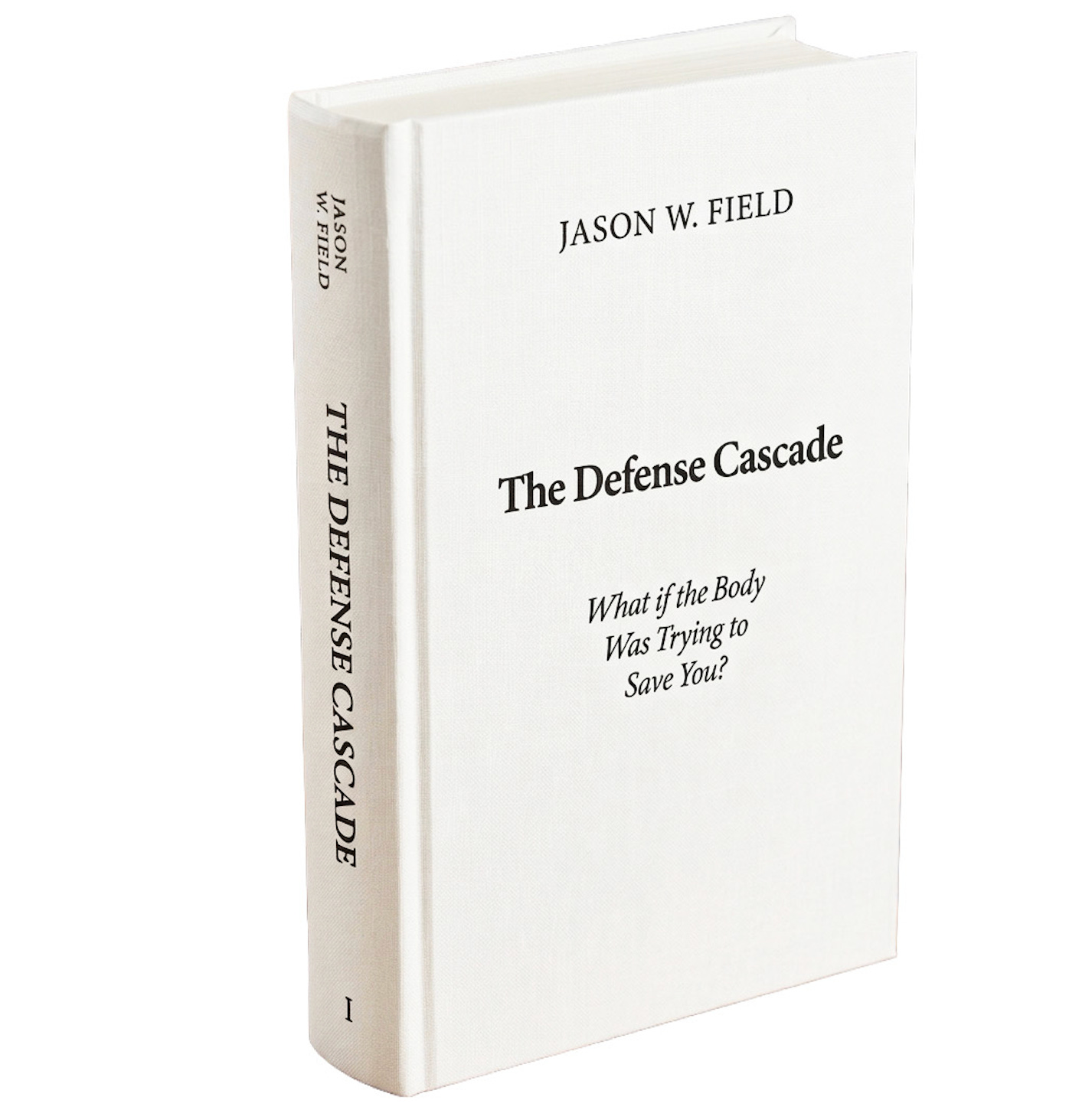
That said, I launched the ‘Somatic Academy’ today. The first module is live: The Defense Cascade - What if the Body Was Trying to Save You.’ Unsurprisingly, given what I mentioned above about my note-taking, a book is also available for independent digestion or as a course companion, with over 1,600 references.
That reference list is another reminder that there is no shortage of evidence for understanding how the body responds to adversity, holds adversity and resolves adversity. The problem is with us. We have a preconception that body-led approaches are a bit goo-goo-ga-ga for elephant-pants-wearing backpackers in Thailand or Ubud. Yet, it’s basically the opposite. Body-led approaches are easily observable, founded biologically, and far more effective than cognitive-only approaches. Whereas cognitive is often purely theoretical and has barely updated over the decades, despite the deluge of data that modern science has provided us.
A simple example to illustrate the point is panic disorder. We have compassion for the psychologist’s behaviour in handing me that piece of paper, because it was born of a belief. What belief? Well, read a textbook, and it will describe how cognitive interventions are designed to improve top-down activation of the DLPFC to dampen the amygdala and thus turn off excessive bottom-up responses that drive panic disorder.
But guess what? If you remove someone’s amygdala, they are more likely to have a panic attack than someone with a functioning amygdala, and the higher your DLPFC activation prior to CBT, the more likely you will not only receive no benefit from the intervention, but it will also increase your fear of bodily symptoms. What’s the DLPFC doing? It's carrying out a passive response that occurs in lock-step with patients’ lower feelings of safety in their bodies. All data that is not new, but has failed to filter from the species library to the front-line defenders. A failure, with any luck, this project will help to repair.
So the goal for this module, should it be of interest, involves a ride up the defense cascade from an intergenerational, epigenetic and cultural perspective with a continuous comparison of mass market and body-led approaches at each step of the way. Sprinkled in is lived experience, which will no doubt help practitioners understand what it is like to live within the skin of someone presenting separation anxiety, selective mutism, hyperhidrosis, agoraphobia, panic disorder, ADHD, ASD, c-PTSD, dissociation, etc., etc., etc so that we can pull together the thread of predictable responses to irrational demands, and find the nozzles of change, rather than simply building a personality prison that diagnosing and dispensing tends to result in.
Should any of this be of interest, I encourage you to visit the ‘Somatic Academy’ page.
Please note that while this is prepared for practitioners, curious individuals are welcome to enrol; however, it is highly recommended that you engage with this material as a complementary asset alongside your private therapy sessions.

If the book is more your style, or you’d like it as a study companion, it is now available on Amazon: USA, UK, Germany, France, Spain, Italy, Netherlands, Poland, Sweden, Belgium, Ireland, Japan, Canada, Australia.
As always, to your healing 💙,
Jas
Oh dear, I'm new here but not in the world. I appreciate your work immensely👍